Fingertip trajectory recognition
1. Introduction
MediaPipe is a data stream processing machine learning application development framework developed and open-source by Google. It is a graph based data processing pipeline used to build and utilize various forms of data sources, such as video, audio, sensor data, and any time series data.
MediaPipe is cross platform and can run on embedded platforms (such as Raspberry Pi), mobile devices (iOS and Android), workstations, and servers, with support for mobile GPU acceleration. MediaPipe provides cross platform, customizable ML solutions for real-time and streaming media.
The core framework of MediaPipe is implemented in C++and provides support for languages such as Java and Objective C. The main concepts of MediaPipe include packets, streams, calculators, graphs, and subgraphs.
Features of MediaPipe:
-End to end acceleration: Built in fast ML inference and processing can accelerate even on regular hardware.-Build once, deploy anytime, anywhere: A unified solution suitable for Android, iOS, desktop/cloud, web, and IoT.-Ready to use solution: a cutting-edge ML solution that showcases all the functionalities of the framework.-Free and open-source: frameworks and solutions under Apache 2.0, fully extensible and customizable.
2. Start
2.1 Program description
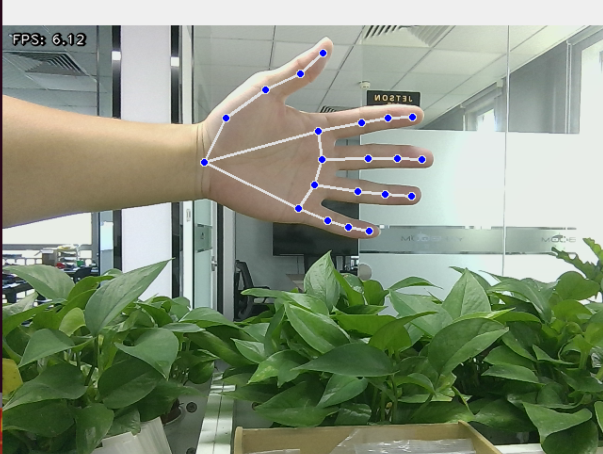
After the program starts, the camera captures an image and places the palm on the camera screen. The image will draw the joints on the palm.
2.2 Start program
- Input following command to start the program
roslaunch jetcobot_advance finger_trajectory.launch
2.3 About code
Code path:~/jetcobot_ws/src/jetcobot_advance/scripts/finger_trajectory.py
#!/usr/bin/env python3
# coding: utf8
import os
import enum
import cv2
import time
import numpy as np
import mediapipe as mp
import rospy
import queue
from pymycobot.mycobot import MyCobot
from sensor_msgs.msg import Image
import fps
from vutils import distance, vector_2d_angle, get_area_max_contour
import gc


def get_hand_landmarks(img, landmarks):
"""
将landmarks从medipipe的归一化输出转为像素坐标
:param img: 像素坐标对应的图片
:param landmarks: 归一化的关键点
:return:
"""
h, w, _ = img.shape
landmarks = [(lm.x * w, lm.y * h) for lm in landmarks]
return np.array(landmarks)


def hand_angle(landmarks):
"""
计算各个手指的弯曲角度
:param landmarks: 手部关键点
:return: 各个手指的角度
"""
angle_list = []
# thumb
angle_ = vector_2d_angle(landmarks[3] - landmarks[4], landmarks[0] - landmarks[2])
angle_list.append(angle_)
# index finger
angle_ = vector_2d_angle(landmarks[0] - landmarks[6], landmarks[7] - landmarks[8])
angle_list.append(angle_)
# middle finger
angle_ = vector_2d_angle(landmarks[0] - landmarks[10], landmarks[11] - landmarks[12])
angle_list.append(angle_)
# ring finger
angle_ = vector_2d_angle(landmarks[0] - landmarks[14], landmarks[15] - landmarks[16])
angle_list.append(angle_)
# pinky
angle_ = vector_2d_angle(landmarks[0] - landmarks[18], landmarks[19] - landmarks[20])
angle_list.append(angle_)
angle_list = [abs(a) for a in angle_list]
return angle_list


def h_gesture(angle_list):
"""
通过二维特征确定手指所摆出的手势
:param angle_list: 各个手指弯曲的角度
:return : 手势名称字符串
"""
thr_angle, thr_angle_thumb, thr_angle_s = 65.0, 53.0, 49.0
if (angle_list[0] < thr_angle_s) and (angle_list[1] < thr_angle_s) and (angle_list[2] < thr_angle_s) and (
angle_list[3] < thr_angle_s) and (angle_list[4] < thr_angle_s):
gesture_str = "five"
elif (angle_list[0] > 5) and (angle_list[1] < thr_angle_s) and (angle_list[2] > thr_angle) and (
angle_list[3] > thr_angle) and (angle_list[4] > thr_angle):
gesture_str = "one"
else:
gesture_str = "none"
return gesture_str


class State(enum.Enum):
NULL = 0
TRACKING = 1
RUNNING = 2


def draw_points(img, points, tickness=4, color=(255, 0, 0)):
"""
将记录的点连线画在画面上
"""
points = np.array(points).astype(dtype=np.int32)
if len(points) > 2:
for i, p in enumerate(points):
if i + 1 >= len(points):
break
cv2.line(img, tuple(p), tuple(points[i + 1]), color, tickness)

def get_track_img(points):
"""
用记录的点生成一张黑底白线的轨迹图
"""
points = np.array(points).astype(dtype=np.int32)
x_min, y_min = np.min(points, axis=0).tolist()
x_max, y_max = np.max(points, axis=0).tolist()
track_img = np.full([y_max - y_min + 100, x_max - x_min + 100, 1], 0, dtype=np.uint8)
points = points - [x_min, y_min]
points = points + [50, 50]
draw_points(track_img, points, 1, (255, 255, 255))
return track_img


class FingerTrajectoryNode:
def __init__(self):
rospy.init_node('finger_trajectory')
self.drawing = mp.solutions.drawing_utils
self.timer = time.time()

self.hand_detector = mp.solutions.hands.Hands(
static_image_mode=False,
max_num_hands=1,
min_tracking_confidence=0.05,
min_detection_confidence=0.6
)


self.fps = fps.FPS()  # fps计算器
self.state = State.NULL
self.points = []
self.start_count = 0
self.no_finger_timestamp = time.time()

self.mc = MyCobot(str(os.getenv('MY_SERIAL')), 1000000)
self.mc.send_angles([0, 0, -90, 90, 0, -45], 50)

self.gc_stamp = time.time()
self.image_queue = queue.Queue(maxsize=1)
source_image_topic = rospy.get_param('~source_image_topic', '/camera/color/image_raw')
rospy.loginfo("source_image_topic = {}".format(source_image_topic))
self.image_sub = rospy.Subscriber(source_image_topic, Image, self.image_callback, queue_size=1)


def image_callback(self, ros_image: Image):
try:
self.image_queue.put_nowait(ros_image)
except Exception as e:
pass

def image_proc(self):
#    rospy.loginfo('Received an image! ')
ros_image = self.image_queue.get(block=True)
rgb_image = np.ndarray(shape=(ros_image.height, ros_image.width, 3), dtype=np.uint8, buffer=ros_image.data)
rgb_image = cv2.flip(rgb_image, 1) # 水平翻转
result_image = np.copy(rgb_image)
result_call = None
if self.timer <= time.time() and self.state == State.RUNNING:
self.state = State.NULL
try:
results = self.hand_detector.process(rgb_image) if self.state != State.RUNNING else None
if results is not None and results.multi_hand_landmarks:
gesture = "none"
index_finger_tip = [0, 0]
self.no_finger_timestamp = time.time()  # 记下当期时间,以便超时处理
for hand_landmarks in results.multi_hand_landmarks:
self.drawing.draw_landmarks(
result_image,
hand_landmarks,
mp.solutions.hands.HAND_CONNECTIONS)
landmarks = get_hand_landmarks(rgb_image, hand_landmarks.landmark)
angle_list = (hand_angle(landmarks))
gesture = (h_gesture(angle_list))
index_finger_tip = landmarks[8].tolist()

if self.state == State.NULL:
if gesture == "one":  # 检测到单独伸出食指,其他手指握拳
self.start_count += 1
if self.start_count > 20:
self.state = State.TRACKING
self.points = []
else:
self.start_count = 0

elif self.state == State.TRACKING:
if gesture == "five": # 伸开五指结束画图
self.state = State.NULL

#  # translated to English (best-effort)
track_img = get_track_img(self.points)
contours = cv2.findContours(track_img, cv2.RETR_EXTERNAL, cv2.CHAIN_APPROX_NONE)[-2]
contour = get_area_max_contour(contours, 300)
contour = contour[0]
#  # translated to English (best-effort)
# cv2.fillPoly  # translated to English (best-effort)
track_img = cv2.fillPoly(track_img, [contour,], (255, 255, 255))
for _ in range(3):
#  # translated to English (best-effort)
track_img = cv2.erode(track_img, cv2.getStructuringElement(cv2.MORPH_RECT, (5, 5)))
#  # translated to English (best-effort)
track_img = cv2.dilate(track_img, cv2.getStructuringElement(cv2.MORPH_RECT, (5, 5)))
contours = cv2.findContours(track_img, cv2.RETR_EXTERNAL, cv2.CHAIN_APPROX_NONE)[-2]
contour = get_area_max_contour(contours, 300)
contour = contour[0]
h, w = track_img.shape[:2]

track_img = np.full([h, w, 3], 0, dtype=np.uint8)
track_img = cv2.drawContours(track_img, [contour, ], -1, (0, 255, 0), 2)
#  # translated to English (best-effort)
approx = cv2.approxPolyDP(contour, 0.026 * cv2.arcLength(contour, True), True)
track_img = cv2.drawContours(track_img, [approx, ], -1, (0, 0, 255), 2)

print(len(approx))
#  # translated to English (best-effort)
if len(approx) == 3:
cv2.putText(track_img, 'Triangle', (10, 40),cv2.FONT_HERSHEY_SIMPLEX, 1.2, (255, 255, 0), 2)
if len(approx) == 4 or len(approx) == 5:
cv2.putText(track_img, 'Square', (10, 40),cv2.FONT_HERSHEY_SIMPLEX, 1.2, (255, 255, 0), 2)
if 5 < len(approx) < 10:
cv2.putText(track_img, 'Circle', (10, 40),cv2.FONT_HERSHEY_SIMPLEX, 1.2, (255, 255, 0), 2)
if len(approx) == 10:
cv2.putText(track_img, 'Star', (10, 40),cv2.FONT_HERSHEY_SIMPLEX, 1.2, (255, 255, 0), 2)

cv2.imshow('track', track_img)

else:
if len(self.points) > 0:
if distance(self.points[-1], index_finger_tip) > 5:
self.points.append(index_finger_tip)
else:
self.points.append(index_finger_tip)

draw_points(result_image, self.points)
else:
pass
else:
if self.state == State.TRACKING:
if time.time() - self.no_finger_timestamp > 2:
self.state = State.NULL
self.points = []

except BaseException as e:
rospy.logerr("e = {}".format(e))


self.fps.update()
self.fps.show_fps(result_image)
result_image = cv2.cvtColor(result_image, cv2.COLOR_RGB2BGR)
cv2.imshow('image', result_image)
key = cv2.waitKey(1)

if key == ord(' '): # 按空格清空已经记录的轨迹
self.points = []
if time.time() > self.gc_stamp:
self.gc_stamp = time.time() + 1
gc.collect()

if __name__ == "__main__":
finger_track_node = FingerTrajectoryNode()
while not rospy.is_shutdown():
try:
finger_track_node.image_proc()
except Exception as e:
rospy.logerr(str(e))