Face Detection
Face Detection
1. Introduction
MediaPipe is an open-source data stream processing machine learning application development framework developed by Google. It is a graph-based data processing pipeline used to build data sources in various forms, such as video, audio, sensor data, and any time series data. MediaPipe is cross-platform and can run on embedded platforms (Raspberry Pi, etc.), mobile devices (iOS and Android), workstations and servers, and supports mobile GPU acceleration. MediaPipe provides cross-platform, customizable ML solutions for real-time and streaming media. The core framework of MediaPipe is implemented in C++ and provides support for languages such as Java and Objective C. The main concepts of MediaPipe include packets, streams, calculators, graphs, and subgraphs.
Features of MediaPipe:
- End-to-end acceleration: built-in fast ML inference and processing can be accelerated even on ordinary hardware.
- Build once, deploy anywhere: unified solution for Android, iOS, desktop/cloud, web and IoT.
- Ready-to-use solution: cutting-edge ML solution that demonstrates the full capabilities of the framework.
- Free and open source: framework and solution under Apache2.0, fully extensible and customizable.
2. Dlib
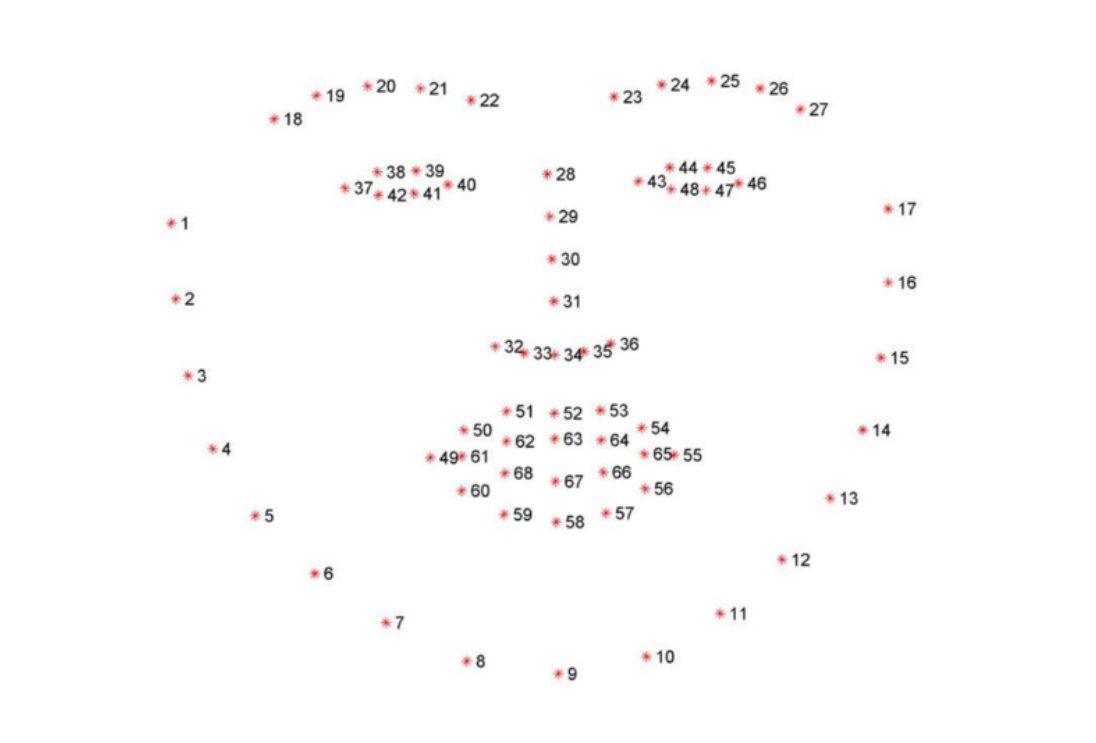
DLIB is a modern C++ toolkit that contains machine learning algorithms and tools for creating complex software in C++ to solve real-world problems. It is widely used by industry and academia in fields such as robotics, embedded devices, mobile phones and large high-performance computing environments. The dlib library uses 68 points to mark important parts of the face, such as 18-22 points mark the right eyebrow, and 51-68 marks the mouth. Use the get_frontal_face_detector module of the dlib library to detect faces, and use the shape_predictor_68_face_landmarks.dat feature data to predict facial feature values.
3. Face Detection
3.1 Start
- Input following command to start the program
roscore
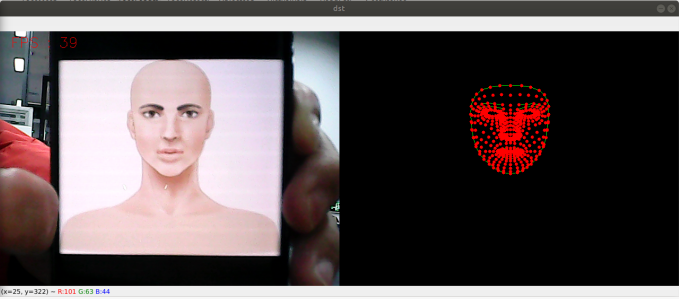
rosrun jetcobot_mediapipe 04_FaceMesh.py
3.2 About code
Code path:~/jetcobot_ws/src/jetcobot_mediapipe/scripts/04_FaceMesh.py
#!/usr/bin/env python3
# encoding: utf-8
import time
import rospy
import cv2 as cv
import numpy as np
import mediapipe as mp
from geometry_msgs.msg import Point
from yahboomcar_msgs.msg import PointArray


class FaceMesh:
def __init__(self, staticMode=False, maxFaces=2, minDetectionCon=0.5, minTrackingCon=0.5):
self.mpDraw = mp.solutions.drawing_utils
self.mpFaceMesh = mp.solutions.face_mesh
self.faceMesh = self.mpFaceMesh.FaceMesh(
static_image_mode=staticMode,
max_num_faces=maxFaces,
min_detection_confidence=minDetectionCon,
min_tracking_confidence=minTrackingCon )
self.pub_point = rospy.Publisher('/mediapipe/points', PointArray, queue_size=1000)
self.lmDrawSpec = mp.solutions.drawing_utils.DrawingSpec(color=(0, 0, 255), thickness=-1, circle_radius=3)
self.drawSpec = self.mpDraw.DrawingSpec(color=(0, 255, 0), thickness=1, circle_radius=1)

def pubFaceMeshPoint(self, frame, draw=True):
pointArray = PointArray()
img = np.zeros(frame.shape, np.uint8)
imgRGB = cv.cvtColor(frame, cv.COLOR_BGR2RGB)
self.results = self.faceMesh.process(imgRGB)
if self.results.multi_face_landmarks:
for i in range(len(self.results.multi_face_landmarks)):
if draw: self.mpDraw.draw_landmarks(frame, self.results.multi_face_landmarks[i], self.mpFaceMesh.FACEMESH_CONTOURS, self.lmDrawSpec, self.drawSpec)
self.mpDraw.draw_landmarks(img, self.results.multi_face_landmarks[i], self.mpFaceMesh.FACEMESH_CONTOURS, self.lmDrawSpec, self.drawSpec)
for id, lm in enumerate(self.results.multi_face_landmarks[i].landmark):
point = Point()
point.x, point.y, point.z = lm.x, lm.y, lm.z
pointArray.points.append(point)
self.pub_point.publish(pointArray)
return frame, img

def frame_combine(slef,frame, src):
if len(frame.shape) == 3:
frameH, frameW = frame.shape[:2]
srcH, srcW = src.shape[:2]
dst = np.zeros((max(frameH, srcH), frameW + srcW, 3), np.uint8)
dst[:, :frameW] = frame[:, :]
dst[:, frameW:] = src[:, :]
else:
src = cv.cvtColor(src, cv.COLOR_BGR2GRAY)
frameH, frameW = frame.shape[:2]
imgH, imgW = src.shape[:2]
dst = np.zeros((frameH, frameW + imgW), np.uint8)
dst[:, :frameW] = frame[:, :]
dst[:, frameW:] = src[:, :]
return dst


if __name__ == '__main__':
rospy.init_node('FaceMesh', anonymous=True)
capture = cv.VideoCapture(0)
capture.set(6, cv.VideoWriter.fourcc('M', 'J', 'P', 'G'))
capture.set(cv.CAP_PROP_FRAME_WIDTH, 640)
capture.set(cv.CAP_PROP_FRAME_HEIGHT, 480)
print("capture get FPS : ", capture.get(cv.CAP_PROP_FPS))
pTime, cTime = 0, 0
face_mesh = FaceMesh(maxFaces=2)
while capture.isOpened():
ret, frame = capture.read()
# frame = cv.flip(frame, 1)
frame, img = face_mesh.pubFaceMeshPoint(frame,draw=False)
if cv.waitKey(1) & 0xFF == ord('q'): break
cTime = time.time()
fps = 1 / (cTime - pTime)
pTime = cTime
text = "FPS : " + str(int(fps))
cv.putText(frame, text, (20, 30), cv.FONT_HERSHEY_SIMPLEX, 0.9, (0, 0, 255), 1)
dst = face_mesh.frame_combine(frame, img)
cv.imshow('dst', dst)
# cv.imshow('frame', frame)
# cv.imshow('img', img)
capture.release()
cv.destroyAllWindows()